


What kind of model is proposed for the solution of the Kurdish problem
14/06/2026
What kind of model is proposed for the solution of the Kurdish problem
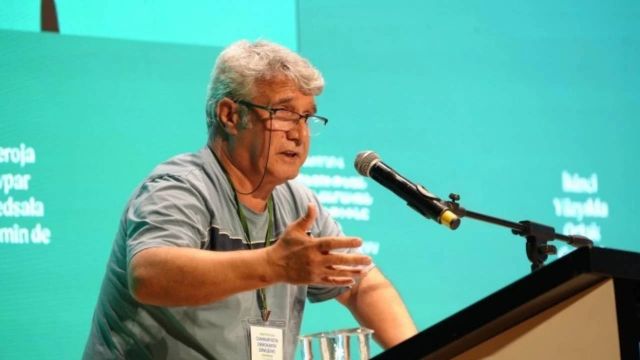
Speaking at the 'Conference on the Democratic Transformation of the Republic in the Second Century', Veysi Aktaş detailed the 'democratic integration' approach that Abdullah Öcalan has recently highlighted.
The “Conference on the Democratic Transformation of the Republic in the Second Century” in Istanbul continues with sessions where important topics are discussed.
Veysi Aktaş, who is at the İmralı Secretariat, made a presentation titled "Democratic Integration and the Construction of Common Life in the Solution of the Kurdish Issue" in the third session of the conference.
Stating that he wanted the discussions at the conference to contribute to the democratization of the country, Aktaş wished that the idea of a democratic republic would develop.
Aktaş said, "Today, we are gathering here at one of the most critical, most hopeful and transformative moments of our history. It is time for the 'Peace and Democratic Society Process', which has gained momentum as of the end of 2024, to become the key to a concrete transformation. This process sprouted with the visionary calls of Mr. Devlet Bahçeli and gained a paradigmatic route and depth with the messages conveyed by the Kurdish People's Leader Mr. Abdullah Öcalan from İmralı. Mr. Özgür Özel's obstructionist approach "It was important to avoid this. And it started to take shape with the will of the President," he said.
'BAHÇELİ'S CALL IGNITED THE PROCESS'
Emphasizing that every major historical-social transformation begins with bold steps, Aktaş said:
"In October 2024, MHP leader Mr. Devlet Bahçeli's historic call in the Parliament officially ignited the process. This call was a call, 'Let politics come to the parliament.' He invited Mr. Öcalan to the Parliament and it was very important. This brought the classical security paradigm to the ground of democratic politics. February 27, 2025 was the turning point of this process. This work was 33 pages, reduced to 12 articles. With the agreement made with the state, it was released. removed.
Kurdish People's Leader Mr. Abdullah Öcalan called for the disarmament and dissolution of the PKK and declared 'the end of the violent struggle'. This call, beyond being a unilateral declaration of will, opened the door to an era in which democratic politics made guns meaningless. The PKK's termination congress, declaration of ceasefire, steps to withdraw its forces and symbolic disarmament ceremonies (developments in July 2025) expressed the sincerity of the Kurdish side and concrete progress.
DEMOCRATIC INTEGRATION
In February 2026, on the first anniversary of the process, Mr. Öcalan's new message made the vision even clearer: He talked about the transition from 'negative peace (only lack of conflict) to positive peace (building a common future)'. Here, the concept of 'democratic integration' took center stage. Perhaps this is the last opportunity for Türkiye. No one could have made this call other than Mr. Abdullah Öcalan. This was very valuable for Türkiye. This opportunity must be evaluated correctly. If you act bravely, this process will develop.
Mr. Öcalan described the idea of democratic integration as a step 'as important as the establishment of the republic'. Democratic society, democratic negotiation, democratic republic and democratic integration; They are the building blocks of the mentality of the new era and a new democratic Türkiye. The concept has come to the fore especially in Mr. Öcalan's writings and in recent peace process discussions.
According to Mr. Öcalan, democratic integration is the integration of the Kurdish society into the democratic republic as a 'democratic society'; It is not separatism, but integration on the basis of equality. This is recommended for Türkiye as well as other countries where Kurds live (Iraq, Syria, Iran).
'EQUAL RIGHTS AND MUTUAL RECOGNITION'
Democratic integration offers a third way between assimilation and separatism: Equal and free coexistence in diversity, its basic philosophy being 'integrity in diversity'. It is seen as the key to sustainable peace and democratization. Democratic integration is a concept used especially in the context of the Kurdish issue and peace process in Türkiye. Essentially, it refers to the voluntary integration of different ethnic, cultural or belief communities into the democratic political order, without assimilation (forced assimilation), on the basis of equal rights and mutual recognition.
'NEITHER VICTORY NOR SURRENDER'
Democratic integration aims to overcome the conflicts created by the monist, monist and denialist nation-state model and is based on the philosophy of 'unity/integrity in diversity'. Besides, democratic integration is neither the victory of one side nor the surrender of the other. On the contrary, it is a new move towards democracy that embraces us all in the second century of the Republic.
MAIN FEATURES OF INTEGRATION
The main foundations (features) of democratic integration can be summarized as follows:
1-Mutual Recognition: Acceptance of the existence of different identities (ethnic, linguistic, cultural) and recognition as political subjects. It is essential to recognize collective rights (language, culture, historical memory) as well as individual rights. When recognition is denied, conflict arises; Recognition, in this sense, is the basis of peace.
2- Principle of Equal Citizenship and Equality: All communities have equal rights within the same political order. It is emphasized that communities do not have to be similar to each other, but can have equal status. This includes legal equality and equality of opportunity.
3-Democratic Negotiation and Voluntarism: Integration occurs through free will and negotiation, not through coercion or imposition. Democratic negotiation requires a constant dialogue mechanism between society and the state.
4- Integrity (Unity) in Difference: A model in which differences are not rejected as a universal principle, but are seen as richness. It is the opposite of assimilation (uniformism); Differences are preserved and people live together under a common and democratic political roof.
5- Management mechanisms should be shared, inclusive and democratic (for example, power sharing in local governments, political participation channels); This includes rejection of anti-democratic practices such as power sharing, democratic institutionalization and trusteeship.
6-Legal and Constitutional Basis: New legal regulations ('peace laws' or 'democratic integration laws'), constitutional guarantees (language and cultural rights, definition of equal citizenship and creation of transitional justice mechanisms).
3 BASIC LAWS
Democratic integration is neither assimilation nor submission. It is a model in which every identity is recognized, equal and free citizenship is strengthened, and local democracy develops. It is not limited only to the Kurdish issue; The democratization of the whole of Türkiye, in this sense, means healing all social wounds. It aims for Turkish-Kurdish unity and the democratic unity of all ethno-religious identities around the idea of a 'common homeland'. The backbone of this vision forms the three basic laws proposed by Mr. Öcalan:
1- Democratic Society Law: Institutionalizes democratic consensus, pluralism and peace culture. In other words, it is constitutionally guaranteed. It builds a common future as an alternative to discriminatory approaches.